Most hydraulic systems are built to stay in one place, bolted to a floor and wired into plant power. A lot of work doesn’t happen in places like that. Levee gates need backup power during a storm. Military ground support equipment moves from one pad to the next. Pipeline crews, bridge contractors, and power plant outage teams need serious hydraulic force where there may be no outlet at all.
A mobile hydraulic power unit (HPU) is built for those jobs. It brings pressure, flow, and control to the work site so you don’t have to bring the work to the power.
This blog covers what separates portable and mobile HPUs from stationary units, when one is the right choice, and what to specify before you order.
What Is A Portable Or Mobile Hydraulic Power Unit?
A hydraulic power unit is the heart of any hydraulic system: a prime mover (an electric motor or an engine) drives a pump, which pushes fluid from a reservoir through valves to do work.
A portable or mobile hydraulic power unit has the same parts, packaged so the unit can be moved and set up quickly. The common forms are:
- Skid-mounted units with lifting points or a crane cage, moved by forklift or crane
- Compact engine-driven units that run on their own fuel supply, with no plant power needed
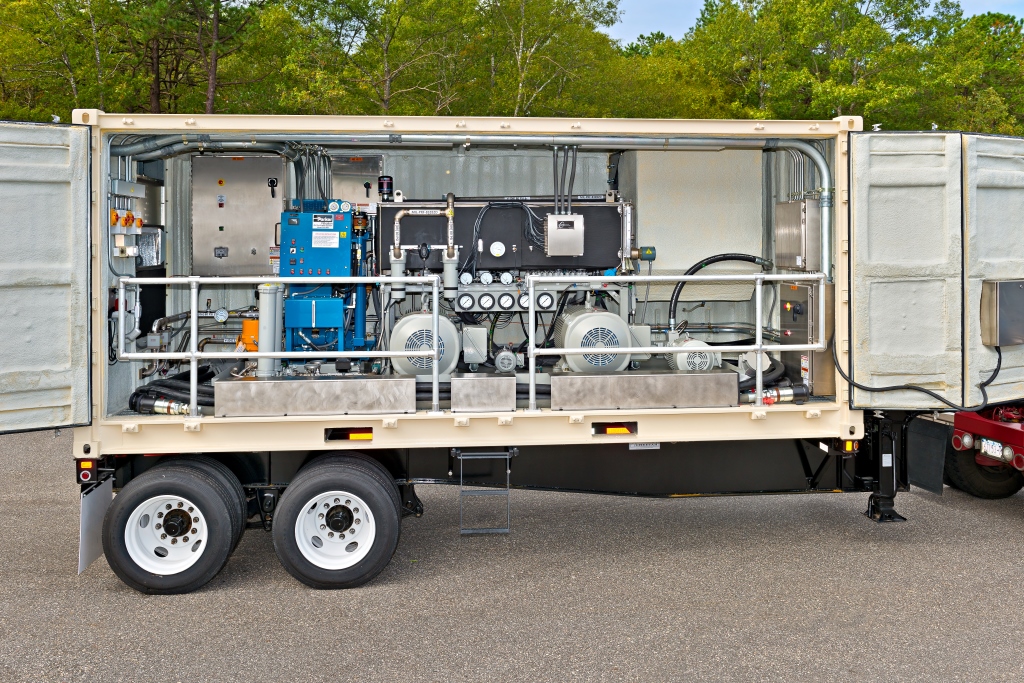
- Trailer-mounted (towable) HPUs: complete systems on a road-legal trailer that can be hitched and moved between sites
Atlantic Hydraulic Systems designs and builds all three. Our Mobile Hydraulic Power Unit packages are custom-engineered on a towable trailer. They can be diesel or electrically driven and are ruggedized to handle road shock and vibration.
When Does Job-Site Flexibility Matter?
A mobile unit is worth it when one or more of the following is true.
There’s no reliable power where the work happens
Remote pipelines, dams, bridges, and construction sites often have no three-phase power. A diesel HPU carries its own energy source and can run for a full shift on its fuel tank.
You need emergency or backup hydraulic power
Flood gates, turbine systems, and other critical equipment can’t wait for the grid to come back.
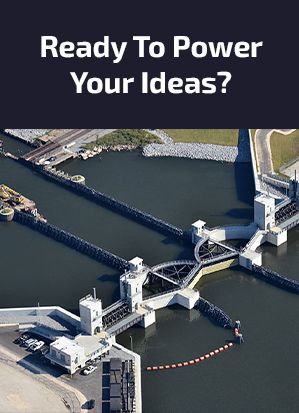
A compact diesel unit can be staged as an emergency backup and started when it’s needed. Our work on hydraulic levee gates during Hurricane Ida and in flood control reliability shows why a redundant power source matters. Accumulators are another layer of protection, covered in hydraulic accumulators in power and system backup.
One unit serves several machines or locations
If a maintenance team services cylinders, jacks or actuators across a large facility or several sites, one well-specified mobile HPU can replace several stationary units that would sit idle most of the time.
The equipment itself moves
Military ground support equipment, entertainment rigs and field test setups are always being moved.
Outages and shutdowns are on a tight schedule
During a power plant outage, every hour counts. A portable unit that arrives ready to connect cuts setup time and keeps the critical path moving.
Diesel Vs. Electric: Choosing The Right Power Source
| Factor | Diesel-driven HPU | Electric-driven HPU |
| Power availability | Fully self-contained | Needs site power or a generator |
| Best for | Remote sites, emergency backup, towable units | Indoor or plant use, noise- or emissions-sensitive areas |
| Noise and emissions | Higher; enclosures and emissions compliance matter | Quieter, with no on-site exhaust |
| Maintenance | Engine service plus hydraulics | Mostly hydraulics |
| Hybrid option | Available: electric motor plus diesel engine | — |
For lower-flow field work, Atlantic’s Deutz diesel HPUs up to 77 HP are built for mobile use and emergency backup. They deliver up to 32 GPM at 2,000 PSI and have a 13-gallon diesel tank. Larger jobs step up to Deutz units up to 208 HP or Caterpillar-powered units up to 1,200 HP.
When a site has shore power some of the time, a combo electric motor/diesel engine unit gives you both options.
Key Specifications For A Mobile HPU
Portability adds design problems that a stationary unit never faces.
Plan for these when you write your specification:
- Flow and pressure. Size to the most demanding tool or actuator the unit will run, with some margin.
- Reservoir size and cooling. Mobile units often run hard in hot or cold weather. Fan coolers, immersion oil heaters and a properly sized reservoir protect the fluid.
- Pump type. A fixed-displacement pump is simple and durable. A pressure-compensated piston pump saves fuel and reduces heat when demand changes.
- Ruggedization. Road shock, vibration and weather wear out fittings, mounts and electronics. Specify vibration-resistant mounting, stainless tank and plumbing where corrosion is a risk, and weatherproof containment.
- Hazardous locations. Oil and gas, chemical and some utility sites need explosion-proof equipment.
- Transport compliance. Trailer-mounted units driven on public roads need the right lighting, braking and registration.
- Noise. Engine-driven units near crews or the public may need sound-attenuating enclosures.
Ready To Take Your Hydraulic Power On The Road?
Tell us about your application: the job, the site conditions and the flow and pressure you need.
We’ll recommend the right portable or mobile HPU. Contact Atlantic Hydraulic Systems through our website or call (631) 234-3131 to talk to our team.