If you work anywhere near industrial equipment — oil and gas processing, power generation, infrastructure, defense, or entertainment — you’ve probably relied on a hydraulic power unit without necessarily thinking about what’s inside the box.
It’s the component doing the quiet, heavy lifting behind everything from a turbine’s control system to a movable flood gate. This blog breaks down what a hydraulic power unit actually is, how it works, the main types available, and what to consider when you’re specifying one for your application.
What Is a Hydraulic Power Unit?
A hydraulic power unit (HPU) is a self-contained system that generates pressurized hydraulic fluid flow to power cylinders, motors, or other actuators elsewhere in a machine.
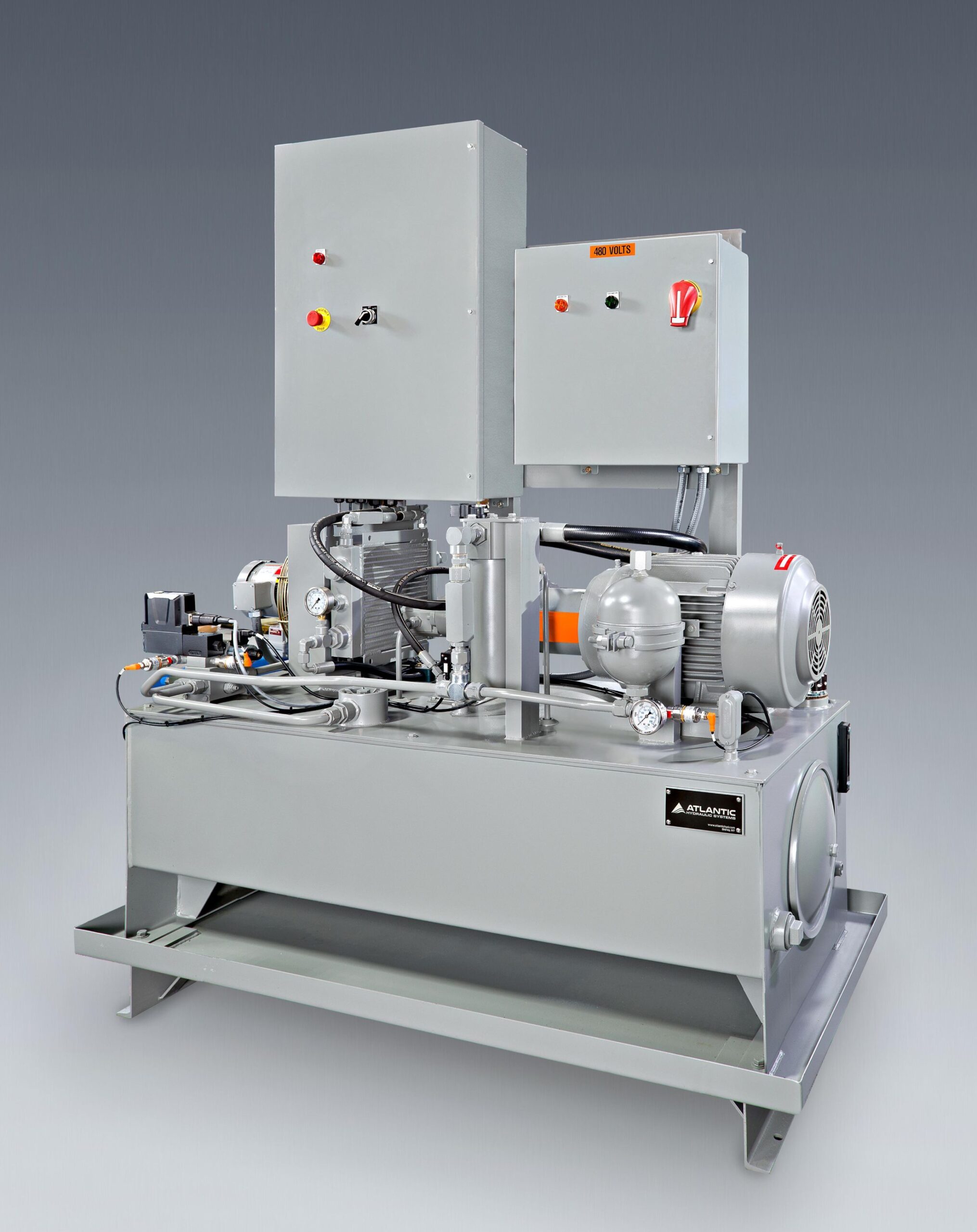
Think of it as the “engine room” of a hydraulic system: everything needed to pressurize and deliver fluid (the pump, motor, reservoir, valves, and controls) is packaged together, so the rest of the machine only needs to connect hoses or pipes to put that power to work.
The underlying physics goes back to Pascal’s Law: pressure applied to a confined fluid transmits equally in all directions, and by varying the size of the pistons involved, a hydraulic system can multiply a relatively small input force into a much larger output force. That’s why hydraulics can move loads that would require enormous electric motors or gearboxes to handle mechanically.
The Core Components of a Hydraulic Power Unit
Every hydraulic power unit, whether it’s a small bench-top unit or a 1,200-horsepower industrial system, is built from the same basic building blocks:
Reservoir: Stores hydraulic fluid, allows entrained air to escape, and dissipates heat. Reservoir design (overhead, stainless, low-noise enclosure) has a real effect on pump life and contamination resistance, which is why Atlantic’s larger HPUs offer overhead reservoir and stainless tank options for demanding-duty applications.
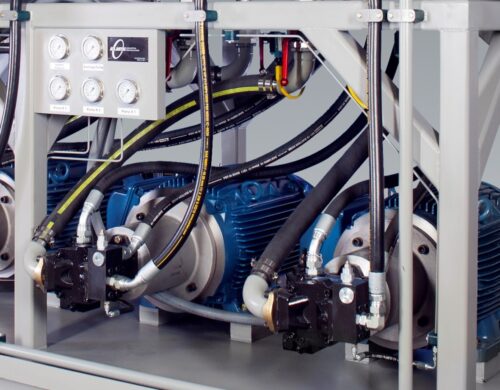
Pump: Converts mechanical energy into hydraulic energy by pushing fluid into the system at pressure. Pump type and sizing directly determine flow rate and how efficiently the unit runs. We partner with Parker Hannifin for most pump components, and Parker’s own hydraulic power unit lineup is a useful reference for how commercial off-the-shelf units are configured.
Prime mover: The motor or engine that drives the pump, typically an electric motor for stationary applications, or a diesel engine where there’s no reliable power grid, such as remote or mobile job sites.
Valves: Direct, regulate, and control the flow, pressure, and direction of the hydraulic fluid. This is what translates raw pump output into controlled, useful motion at the actuator (hydraulic motors and/or cylinders)..
Filtration: Keeps contamination out of the fluid, which is enormously important. Most hydraulic component failures trace back to contaminated fluid rather than the components themselves.
Accumulators: Store hydraulic energy under pressure for backup power, shock absorption, or supplementing pump flow during peak demand.
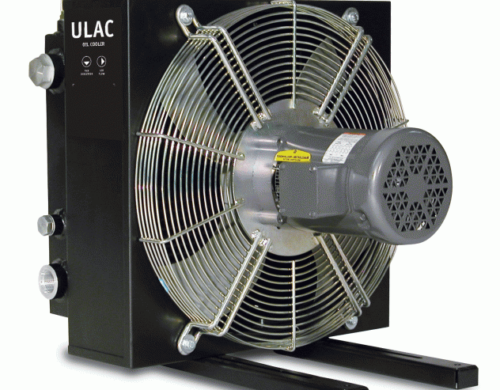
Heat exchangers: Remove the heat generated as fluid is pressurized and moved, critical for duty cycles where the system runs continuously rather than intermittently.
Electrical controls: Motor starters, PLCs, and operator interfaces that tell the unit when to run, how hard, and how to respond to feedback from the rest of the machine. See our electrical controls overview for how this layer typically gets built out.
How a Hydraulic Power Unit Actually Works
Put simply: the prime mover spins the pump; the pump draws fluid from the reservoir and pressurizes it; the valves direct that pressurized fluid to the correct actuator in the correct amount at the correct time; and the fluid returns to the reservoir to be filtered, cooled, and recirculated.
The electrical controls sit on top of all of this, deciding when the pump should run, how the valves should be positioned, and shutting things down safely if pressure, temperature, or flow moves outside acceptable limits.
The complexity comes from how tightly all of this needs to be tuned to the actual application.
A system that’s oversized runs inefficiently and wastes energy on excess flow; a system that’s undersized overheats, wears out early, or simply can’t deliver the force the application needs.
Types of Hydraulic Power Units
Hydraulic power units are generally categorized in a few different ways:
By Horsepower and Complexity
Small units (roughly 1–25 horsepower) cover simpler, lower-flow applications and are often available in standard, off-the-shelf configurations.
Mid-range units (25–100 horsepower) start introducing features like overhead reservoirs, multiple pumps, and enclosed low-noise housings for continuous-duty environments.
Large units (100+ horsepower) — pump skids, pump stands, and fully integrated systems — are typically custom-engineered around a specific machine or process.
By Power Source
Electric-motor-driven units are the default for facilities with reliable grid power.
Diesel-driven units take over where grid power isn’t available or reliable, and combo electric-diesel units give you a backup path if utility power drops.
This choice has a real effect on footprint, noise, emissions compliance, and run cost, so it’s worth working through early in the spec process rather than defaulting to whatever the last project used.
By Environment
Standard enclosures work fine in a typical industrial setting, but hazardous locations (oil and gas facilities, chemical plants, anywhere flammable vapors might be present) require explosion-proof enclosures rated for the specific hazard classification of the site.
Getting this wrong isn’t just an efficiency problem, it’s a safety and code-compliance one.
By Mobility
Fixed installations are the norm, but skid-mounted or trailer-mounted pump skids give you a self-contained unit that can move between job sites. This is common in construction, emergency response, and temporary industrial setups.
How to Choose the Right Hydraulic Power Unit
A few questions determine almost every real HPU spec:
- What pressure and flow rate does your actuator need?
This comes from the cylinder or motor you’re powering, not the other way around. Work backward from the actuator’s requirements to the pump and motor specs that will deliver them. - What’s the duty cycle?
A unit running continuously generates far more heat than one that cycles intermittently, and heat is what drives component wear and shortens service life. Duty cycle should shape your reservoir size, cooling approach, and pump selection just as much as pressure and flow do. - What’s the operating environment?
Temperature extremes, hazardous atmospheres, vibration, and available space all narrow down which configuration actually fits. - Is a standard unit good enough, or do you need something custom?
Standard units are faster to procure and less expensive for straightforward applications. But once you’re dealing with unusual space constraints, or a duty cycle that doesn’t match anything off-the-shelf, a custom-engineered unit almost always outperforms a standard one over its service life. We go through this trade-off in more detail in Custom Hydraulic Power Unit vs. Standard Unit.
When To Go Custom
Standard hydraulic power units cover a lot of ground, but some applications simply don’t fit a catalog part number. Hazardous-location oil and gas equipment, defense systems requiring ITAR-certified manufacturing, and power generation equipment where downtime isn’t an option all tend to need something engineered around the application rather than picked off a shelf.
The tell is usually one of a few things: the space you’re working with doesn’t match any standard footprint, you need PLC logic or feedback control built in rather than bolted on, a certification requirement rules out off-the-shelf options, or your duty cycle runs hotter or harder than a catalog unit is rated for.
When any of those apply, a custom-engineered HPU generally costs more up front but outperforms a standard unit over its actual service life.
Conclusion
A hydraulic power unit only looks simple from the outside. Underneath, it’s a tightly coordinated system of pump, prime mover, valves, filtration, and controls, all sized around the specific pressure, flow, duty cycle, and environment the application demands.
Atlantic Hydraulic Systems has been designing, building, and testing hydraulic power units since 1983. Have a system to spec, troubleshoot, or just talk through? Talk to our team, we’re happy to help.